A tangled topic: slings, carabiners, and QD mounts
Updated: Sep 2
Effective weapon handling isn’t limited to simply holding it in your hands. Sometimes, you just need to free up your hands — whether it’s grabbing a quick bite on the move or operating additional gear. After all, everyone knows that drawing a sidearm is faster than reloading. In such situations, securely stowing your weapon close to the body becomes the optimal solution: it stays easily accessible while keeping your hands free for more pressing tasks.
The modern solution is a sling attachment using QD swivels or carabiners, and the variety of options can easily overwhelm an operator who’s just beginning to explore the topic. We’ve done the homework, and now we’ll show you how KPYK approaches sling mounting.
Attachment types
The most common and straightforward way to attach a sling is via sling swivels — typically located at the rear of the handguard or near the barrel, as well as on the stock when using standard factory hardware. These attachment points can either be integrated into the weapon by the manufacturer or added later as aftermarket accessories.
As weapon platforms evolved, we transitioned from permanently fixed slings — often riveted in place — to clips, then to carabiners, which enabled quicker attachment and removal. Today, the industry standard for sling mounting is the QD system (Quick Detach): detachable swivels that connect to the sling and lock into dedicated QD sockets or cutouts on the weapon itself.

While QD has become a somewhat standardized concept, different manufacturers still take their own approach, which means compatibility can vary, ranging from partial functionality to outright failure, such as unintended disconnection.
In English-language terminology, it’s important to distinguish between a QD sling swivel (the detachable metal stud) and a QD sling mount (the socket or interface it locks into). For clarity in discussion, keeping these terms separate is essential.
Another common method of sling attachment is via carabiners — metal hooks with spring-loaded gates. They have their own pros and cons. On the plus side, they are generally more affordable and highly versatile, allowing them to work with a wide range of gear .However, their drawbacks include a limited range of motion for the sling, which can restrict weapon manipulation. Additionally, larger carabiners may cause metal-on-metal rattle and add unnecessary weight, both undesirable traits in a dynamic environment.

At KPYK, we’ve always prioritized shooter comfort alongside weapon effectiveness. That’s why our lineup includes quick-detach sling swivels in two loop sizes:
CRC 9095A — designed for modern narrow slings up to 25 mm wide,
CRC 9095B — with a 38 mm loop, ideal for those who prefer wider slings like the “tubular” Magpul MS1 or even a classic AK-style web sling — it’ll fit them all.
Unlike fixed mounts or carabiners, these QD swivels allow users to quickly attach or detach their sling as needed, or even relocate the attachment point to a different socket on the weapon, whether to change the carry style or switch shoulders on the fly.
What sling should you pick?
Let’s take a look at several sling attachment setups, starting with the single-point sling. This configuration typically attaches to a QD socket on the stock or to a mount at the rear of the receiver extension (buffer tube). It’s most effective when paired with compact firearms or pistol-caliber carbines (PCCs).
Using a single-point sling on longer rifles can lead to instability during movement unless the weapon is also anchored to gear for added control.
Pros:
Simplicity — very easy to use
Fast shoulder transitions — ideal for switching shoulders during dynamic shooting
Cons:
Poor weapon retention while moving — the rifle tends to swing and bounce around, especially during rapid movement or transitions
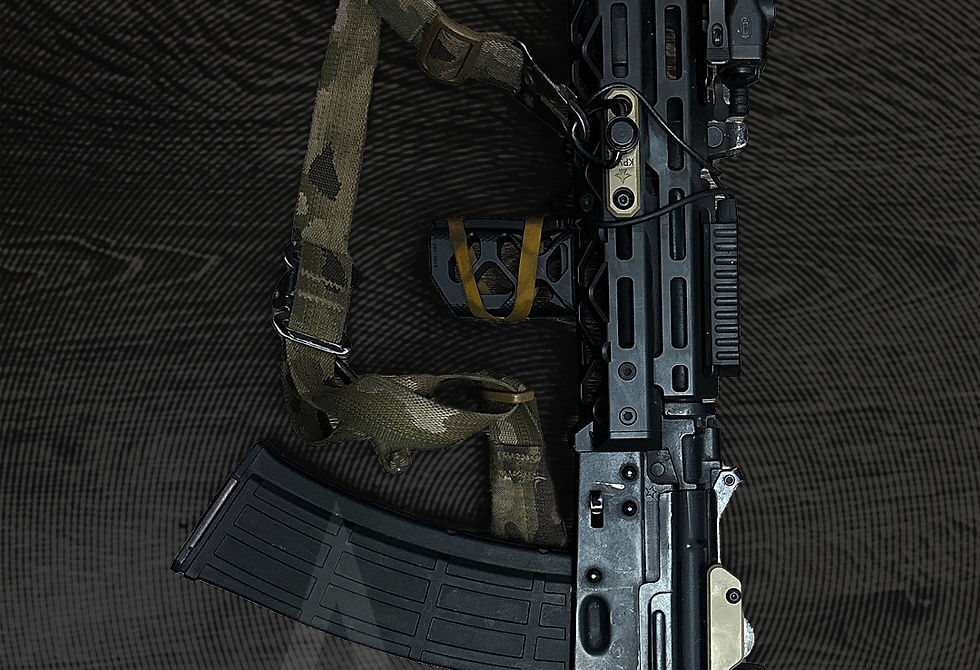
The timeless classic — the two-point sling — attaches to the weapon at two locations, typically on the handguard and the stock. This configuration not only improves weapon retention but also allows for shoulder or back carry and enables the shooter to cinch the rifle tightly to the body, providing additional stability when taking a shot.
Modern two-point slings often come equipped with polymer quick-release buckles for emergency doffing. Subjectively, it’s a near-universal solution — suitable for any shooter and any weapon platform, from lightweight SMGs to full-size rifles and machine guns.
The three-point sling remains the most controversial option among sling systems. Designed for maximum retention and combining features of both one- and two-point slings, it consists of two interconnected loops — one that goes around the shooter’s torso and another that connects to both sling points on the weapon.
This system offers excellent weight distribution, but comes with drawbacks:
Risk of strap entanglement, especially around gear
Complex adjustment, which can result in discomfort when worn with plate carriers or shoulder harnesses
In worst-case scenarios, it can become a liability during high-stress situations
Beyond attachment style, it’s also important to consider sling width — most commonly ranging between 25 mm and 40 mm, depending on the weapon type and user preference.
In the end, no amount of online advice can replace hands-on experience. Each shooter should find what works best through practice and real-world use. Only then can true efficiency and comfort be achieved.
And when you're ready to build your ideal setup, KPYK’s QD sling swivels and mounts will help you dial in a custom solution — and squeeze out that extra few percent of performance that truly matters when it counts.


Comments