History of AR-15 Handguards: From the Jungles of Vietnam to the East of Ukraine
Updated: Aug 28, 2025
The AR-15 is a world-renowned rifle platform, and its evolution spans decades, continuing to advance even today. Over this time, the weapon has undergone numerous changes, with special attention deserved by one of its most critical components — the handguard, and how it has developed through decades of combat and civilian market experience.
From the early prototypes and the wars fought with the “Black Rifle,” to the present day and the conditions of the war in Ukraine, it is time to take a closer look at the AR-15 handguard.
The Origins and Early Modifications
It is no secret that the AR-15 is closely associated with Colt, but the ArmaLite company was behind the creation of the rifle. The first version was developed there in the 1950s, initially conceived as a scaled-down variant of the AR-10 chambered in 5.56×45 mm. Some early prototypes even featured handguards carried over from their “older brother,” made of fiberglass and plastic, while a few custom versions were fitted with custom wooden handguards.
The concept was simple — to protect the shooter’s hands from the heat of the barrel. And although a great deal of time has passed since that first design, the earliest iterations were already quite ergonomic and retained a retro aesthetic that continues to be reproduced and appreciated to this day.

By 1959, the rifle and production rights had been sold to Colt, and the success of its early manufacturing led to the AR-15 being widely fielded by American troops in Vietnam. The jungles of the Indochina region first saw the AR-15 in the form of the M16, where the first generations of rifles — and later the upgraded M16A1 — were equipped with triangular handguards. These are locked into the notches on the upper receiver and the front handguard cap, secured in place by the delta ring.
At that stage of firearm development, it was completely normal for the handguard to rest directly against the barrel. Notably, the M16A1 also addressed a number of issues discovered in combat.
Evolution of the Handguard and Mounting Interfaces
After the year 1967, the M16 underwent a major upgrade with the introduction of a new two-piece handguard. Thanks to the delta ring, the updated handguard could be installed quickly and easily. This configuration remained standard through the 1980s on both civilian and military versions. Also common at the time were three-piece handguards, consisting of the two outer halves combined with an internal aluminum heat shield.

Military M16A2 rifles received an updated tubular handguard — a ribbed, round-profile polymer design with ventilation slots, for which a small range of accessories existed. For example, vertical grips and flashlights could be mounted through the slots on the top or bottom of the handguard, although more often than not, they were secured further with tape or wire.
An interesting fact: when Ukrainian Armed Forces personnel received C7 and M16 rifles donated by Canada or Denmark, there was a small chance they would get one fitted with a vertical grip using this exact type of mounting.

At the end of the war in Indochina and for some time afterward, the standard rifle for the unit’s marksman was typically the M14 or its sniper variant, the M21, equipped with an optical sight. As the lingering stereotypes of the “toy-like and unreliable” M16 began to fade, the M16 platform was recognized as suitable for precision shooting — albeit with some modifications.

Among professionals at the Interservice Rifle Championship (IRC) for U.S. Armed Forces personnel, risers for classic handguards became popular. These were mounted not between the receiver and the handguard cap, but on the barrel nut — minimizing pressure on the barrel and providing a noticeable improvement in shooting accuracy.

Attempts to create free-floating handguards were not limited to military circles and efforts. This highlights a key advantage in the development of the AR-15 as a platform — thanks to its popularity among civilian shooters, huntsmen and sporting enthusiasts, significant capital and research were invested by private companies.
The following decade forced the AR-15 to undergo significant changes — the proliferation of accessories led to widespread use of Picatinny rails, which began appearing on receivers. Although space there was limited, making it mostly suitable for mounting optics, engineers soon turned their attention to the handguards.
The Introduction of the M4 and the SOPMOD Program Results
When discussing the evolution of the AR-15, it is impossible not to mention the M4, adopted in 1994, as its descendants continue to dominate both the military and civilian markets today. The M4 featured various modification packages that significantly enhanced the effectiveness of U.S. troops during the Gulf Wars.
The SOPMOD Block I, which began to be implemented after 1997, allowed the M4 to be equipped with a delta-ring-mounted RIS handguard — the Rail Interface System from Knight’s Armament Company. It featured Picatinny rails on all four sides for attaching a wide array of accessories, enabling operators to build a setup tailored to any mission.

In 2007, a new modification package, SOPMOD Block II, was introduced, which included the Daniel Defense RIS II free-floating handguard with four full-length Picatinny rails.
An outstanding example in the evolution of AR-15 handguards is the Mk12 Special Purpose Rifle — the weapon of a unit marksman responsible for engaging targets at distances beyond the standard M4’s effective range, where shot precision is paramount. The Mk12 program favored the PRI Gen 2 free-floating handguard, which, in addition to mounting on the barrel nut, was secured with a rail attachment to the upper receiver, adding rigidity for zero retention when using optics.
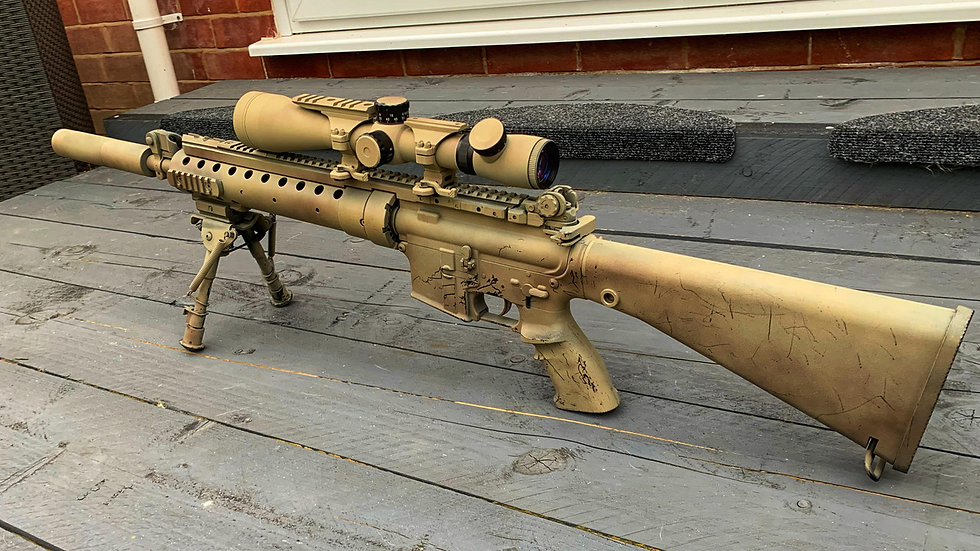
A logical next step in handguard evolution was the replacement of the accessory mounting interface. Starting in 2012, Picatinny rails began to be supplanted by the KeyMod system, which was lighter, more user-friendly, and saved space on the handguard through negative space mounting — mounting directly “in” the handguard rather than on rails.
Through the efforts of Magpul, a few years later, the MOE (Magpul Original Equipment) mounting standard appeared on the market, which eventually evolved into the M-LOK system — now indispensable on modern handguards.
According to testing by the U.S. Marine Corps Research Center and U.S. Special Operations Command, this interface surpasses its predecessor in both mounting reliability and retention. By 2025, it is considered the industry standard, serving as the primary attachment system on M4 rifles modernized to URGI modernization program specifications.

КРУК AR-15 Handguards: Accelerated Evolution
A defining feature in the development of AR-15 handguards and their military variants worldwide has been the initiative of designers, and КРУК handguards emerged as a response to a serious challenge. With russia’s full-scale invasion in 2022, the Armed Forces of Ukraine received a significant number of M16 and Diemaco C7 rifles, mostly from NATO reserves and stockpiles. While the rifles themselves were reliable, age and prior use took their toll. Moreover, these rifles were generally delivered in “surplus configuration,” with old-style handguards that were ergonomically outdated and offered minimal customization — a few steps short of the Vietnam era. Overall, it was difficult to maintain accurate fire with rifles whose handguards were loose and had significant play.

CRC 1AR060 — a long M-LOK handguard for the C7/M16 with a triangular front nut. Installing it does not require altering the handguard mounting system or removing the gas block, and this upgrade can be performed by anyone, even on deployment or when servicing the gun. It modernizes the rifle, allows the attachment of all necessary accessories in modern conflict conditions, and provides sufficient rigidity for use with, for example, an LAM (laser aiming module).

The КРУК handguard lineup also includes a shorter version, the CRC 1AR061, designed for civilian carbines with a mid-length gas system and a fixed sight/gas block, featuring a drop-in handguard design.
The AR-15 has come a long way in its development and is still holding strong positions as a modern firearm actively used in combat, being altered so thoroughly through the years that it barely resembles the gun that went to war in the hands of Marines into the depths of the rainforests back in the '60s. There is no doubt that many innovative solutions await in the future. We are currently working on the release of a new, long-awaited product in the КРУК handguard lineup, and if you’ve read this article to the end, you already know what we’re talking about…


Great overview of how AR-15 handguards have evolved—from early heat shields in Vietnam to today’s lightweight, modular M-LOK systems shaped by modern conflicts. It clearly shows how real-world use drives innovation. More examples of modern designs can be found at https://www.ar15handguard.com/.